Comparisons
Hotel vs Airbnb vs Mid-Stay: Where to Stay in Seoul for 2 Weeks to 3 Months
Planning a 2-week to 3-month stay in Seoul? An honest comparison of hotels, Airbnb, and mid-stay — costs, legality, and what fits your situation.
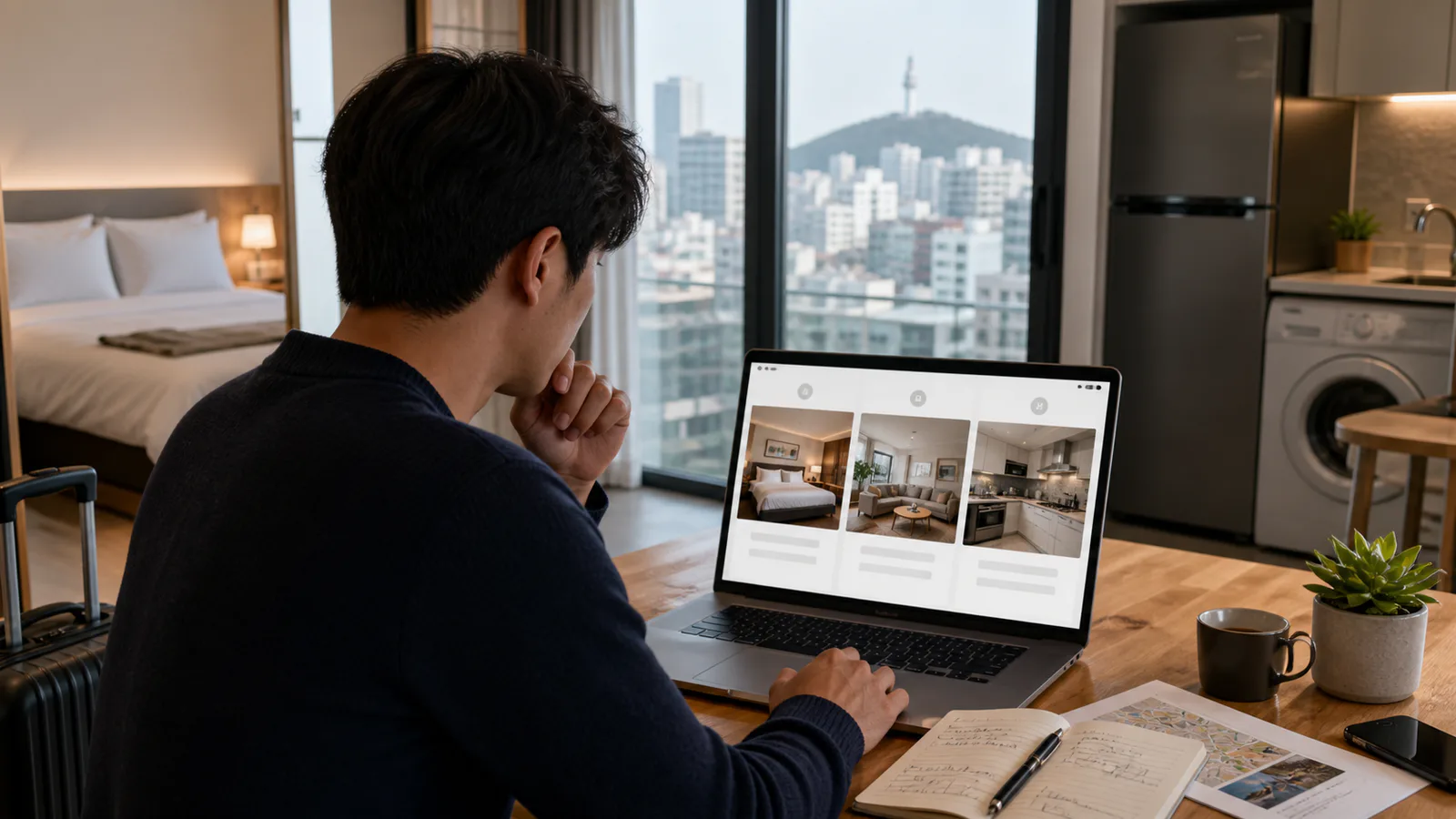
If you are in Seoul for three or four days on business, the answer is obvious — book a hotel. If you have confirmed a year or more of residence, you will need to look into wolse (monthly rent) or jeonse (lump-sum deposit lease).
But what about everything in between? An exchange-student semester, post-surgery recovery, two months as a digital nomad, a short-term corporate posting — the 2-week to 3-month range is the hardest to plan. Hotels are too expensive, Airbnb feels uncertain, and formal leases come with deposits and contract lengths that do not fit. This guide compares all three options honestly and helps you decide what fits your situation. For a four-week search, compare current monthly rentals in Seoul using standardized 28-night totals.
1. Hotel — best for short, worst for long#
Strengths
- Move in immediately, full housekeeping and amenities
- Verified operator, 24/7 front desk
- Clear refund procedure when issues arise
Limitations for stays beyond two weeks
- Cost. A 4-star hotel in Gangnam or Jongno runs ₩130,000–180,000 per night. That is ₩4M–5.4M for thirty days, which is 3–4× what you would pay for a mid-stay.
- Space. A bed and a desk. Working on a laptop is cramped, and there is barely room to unpack a suitcase.
- No kitchen. Every meal is eaten out or delivered. Monthly food costs end up rivaling the room rate.
- Laundry costs. Hotel laundry charges ₩4,000–8,000 per shirt.
- Disconnected from the neighborhood. Hotel lobbies look the same everywhere. You miss out on actually experiencing Seoul.
Best fit: business trips under seven days, or the first few adjustment days right after arrival.
2. Airbnb — flexible globally, a gray zone in Korea#
Airbnb is the standard short-term option in most countries, but Korea is a different story.
Korean regulatory issues
In Korea, legally operating short-term rentals under thirty days requires a formal license — either Foreign Tourist Urban Homestay (외국인관광도시민박업) or Rural Homestay (농어촌민박). Renting out a regular residential unit short-term without one of these licenses sits in legal gray territory. Many Airbnb hosts in Korea operate without proper licensing. When enforcement actions occur, guests have occasionally been asked to leave on short notice.
Other limitations
- Weak host verification. Listings often differ significantly from photos.
- English communication uncertain. Korean hosts' English ability is hit or miss.
- Limited platform accountability in disputes. Refund and mediation processes are slow and unpredictable.
- Hidden fees. Cleaning fees, deposits, and extra-guest charges stack up at checkout.
Best fit: one- to two-week travel, ideally with hosts who hold proper licensing.
3. Mid-stay — built specifically for 2 weeks to 3 months#
A category of services specializing in mid-stay for foreigners has grown rapidly in Korea over the past few years. 33m2 and Enkostay operate as platforms; Locali works as a Seoul housing concierge with curated stays.
Characteristics
- Licensed operation. Most operators hold an e-commerce business registration plus the relevant short-term rental license.
- Fully furnished. Bed, desk, kitchen, washer, Wi-Fi all included. You can move in with a single suitcase.
- Flexible billing. Typically billed in 1–2 week units, with monthly options.
- Foreigner-friendly pricing. 30–50% cheaper than hotels. Slightly more than a fully-furnished monthly lease, but once you add in deposits, maintenance fees, and internet installation, the total comes out about the same or better.
- Low deposit burden. Most foreigner-focused platforms charge little to no deposit.
Cost comparison — 30-day stay in Gangnam, Seoul
| Option | Approx. Cost (KRW) | Notes |
|---|---|---|
| 4-star Hotel | ₩4M–5.4M | Meals and laundry excluded |
| Airbnb (licensed) | ₩2M–3.5M | License and verification vary |
| Mid-stay | ₩1.5M–2.8M | Fully furnished, English support |
| Fully-furnished monthly | ₩800K–1.5M + ₩10M+ deposit | Heavy deposit burden for foreigners |
Best fit: 2 weeks to 3 months (exchange students, medical tourism, digital nomads, short-term corporate postings).
Decision matrix — which one should you choose?#
| Length of stay | 1st choice | 2nd choice |
|---|---|---|
| 1–7 days | Hotel | Airbnb |
| 1–2 weeks | Airbnb | Mid-stay |
| 2 weeks – 3 months | Mid-stay | Fully-furnished monthly |
| 3 months – 1 year | Fully-furnished monthly | Mid-stay |
| 1 year+ | Wolse / Jeonse | — |
Mid-stay checklist — how to avoid scams#
When choosing an operator or a listing, always verify these six items:
- Business registration plus e-commerce license number — publicly disclosed?
- Refund policy — clearly written on the website?
- English communication — confirmed (both operator and host)?
- Unit verification — is there a system that guarantees the photos match reality (for example, a video walkthrough)?
- Payment safety — USD payment, PayPal, or other foreigner-friendly options?
- Dispute responsibility — does the platform take responsibility, or push it onto the host?
Locali — a boutique mid-stay service for foreigners in Seoul#
Locali is a Seoul housing concierge built specifically for foreigners on a mid-stay. We do not list every property in the city. Guests can browse curated stays themselves or ask our Seoul team to search around their needs.
Our four promises:
- Locali Guarantee. In case of fraud or serious issues: full refund plus an equivalent replacement stay within 24 hours.
- Seoul-based accountability. The Locali team handles escalations directly.
- Unit verification on request. After booking, you can request a video walkthrough of the unit, delivered within 24 hours.
- Trust Guarantee Insurance (launching Q4 2026). Up to $5,000 guest protection via partnership with a Korean insurer.
Read the refund and replacement guarantee in full, or see how booking works before browsing.
Bottom line#
For a 2-week to 3-month stay, mid-stay is the most rational option. But 80% of how good your stay turns out depends on which operator you pick. Use the checklist above and choose carefully.

Written by
Simun Yang
Simun lived abroad for 10 years (Australia, Germany, UK) before returning to Korea to build Locali. He writes about housing, language, and the foreigner experience in Seoul.
Keep reading
Guides
How to Verify a Korean Rental Listing Isn't a Scam: A 12-Point Field Guide for Foreigners
May 19, 2026 · 10 min read
Guides
Seoul Short-Term Rentals for Foreigners: 2026 Guide
May 16, 2026 · 16 min read
Guides
Korea Residence Card Housing Documents: Proof of Residence Guide (2026)
August 21, 2026 · 12 min read